The Burnout of Health Optimization
I was tracking everything: macros, sleep, hydration, and steps. And it was making me miserable. Here's why the 'optimized' life often leads to a breaking point.
There was a Tuesday last year when I stared at my phone and realized I hated my "healthy" life.
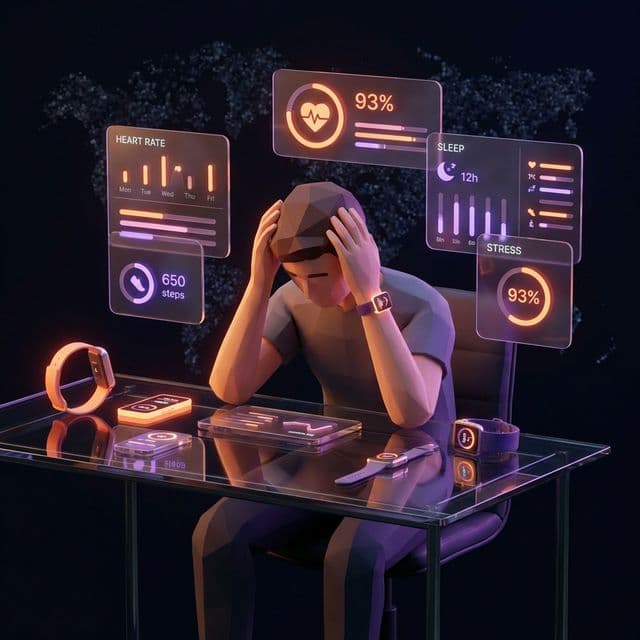
My Apple Watch was buzzing to tell me to stand up. MyFitnessPal was waiting for me to scan the barcode on my lunch. My water tracking app had sent its third notification of the day, demanding I log another glass. My sleep app had informed me that morning that I had only achieved a 72% "recovery score," which preemptively ruined my mood for a workout I felt too tired to do anyway.
I was the very picture of modern health optimization. I had all the data. I had all the charts. I had all the streaks.
And I was completely burned out.
The Data Delusion
We've been sold a narrative over the last decade: if you want to be healthy, you need to quantify everything.
If you aren't tracking your macros, how do you know what you're eating? If you aren't wearing a biometric ring, how do you know if you're sleeping? If you aren't running your life like an Olympic athlete in training, you're falling behind.
So we download the apps. We buy the wearables. We start treating our bodies like chaotic algorithms that need to be tamed with perfectly timed inputs and obsessively monitored outputs.
But here is the problem they don't put in the app store descriptions: data requires management. And management requires energy.
Every time you log a meal, every time you categorize a workout, every time you check your "recovery score," you are spending mental energy. It feels productive at first. It feels like you're taking control. But eventually, the sheer cognitive load of managing your own biology becomes its own source of low-grade, chronic stress.
When the Tool Becomes a Task
The breaking point didn't happen because the apps didn't work. They worked exactly as designed. The breaking point happened because I realized I was spending more energy managing my health data than I was actually enjoying being healthy.
A healthy life is supposed to afford you the energy to do things you love: play with your kids, excel at your work, hike a mountain, or just have enough energy left on a Friday night to go out to dinner.
But when you're strictly optimizing, dinner out becomes a math problem. How many calories are in this restaurant meal? Can I find it in the database? Better overestimate just to be safe. My macros are thrown off for the week now.
Instead of living my life, I was narrating it to my phone.
The Streak Trap
The worst part of the optimization mindset is how it handles failure.
Because the apps define success purely by data continuity (hitting your goals every single day), they turn an imperfect day into an absolute failure. If you break your 45-day logging streak because you went to a wedding and didn't want to scan the buffet, the app doesn't say "Hey, hope you had fun!"
It resets to zero. And the subtle message is: You failed.
This creates a terrifying all-or-nothing dynamic. When I was tracking perfectly, I felt superior. When I inevitably slipped up (because I am a human being, not a machine), I didn't just ease up a bit. Because the streak was broken, I would snap back hard in the other direction. "I already ruined my data for today, might as well order pizza."
Optimization doesn't teach you how to be healthy. It teaches you how to be perfect, and then punishes you when you aren't.
Deleting the Dashboards
That Tuesday, looking at all the red notification badges yelling at me to log my existence, I did something radical.
I deleted them. All of them.
The calorie tracker. The habit tracker. The hydration app. I took off the smart watch.
For the first few days, I felt a weird sort of phantom limb syndrome. I would finish a meal and feel the urge to pull out my phone to record it. I would go for a walk and wonder if it "counted" since it wasn't being tracked on a GPS map.
But by week two, something else happened. The low-grade background anxiety of Have I logged everything? disappeared. I ate lunch when I was hungry. I went to sleep when I was tired.
And yet, I knew I still needed some kind of structure. Stripping away the toxic optimization was important, but "just winging it" rarely leads to long-term health improvements either.
I needed accountability, but I needed it to be nearly invisible. I needed someone to keep me honest, without requiring me to run a data-entry center out of my pocket.
Little did I know, the solution was waiting in the simplest, oldest app on my phone: my text messages.
Stay tuned for Part 2 next week: The Accountability Experiment.
Your wellness goals aren't going to achieve themselves.
Get an AI wellness coach that texts you first, remembers your goals, and keeps you on track — no app required.
Keep reading
The Accountability Experiment
After deleting every health app on my phone, I needed a way to stay on track without the cognitive load. So, I tried something radically simple: a daily text message.
No App Needed: How Text-Based Coaching Actually Works
No downloads, no logins, no friction. Learn how AI wellness coaching works entirely through text messages.